

The Eisenhower Matrix: A Guide to Effective Task Management
In the modern work environment, fraught with distractions and increasing demands, professionals often find themselves overwhelmed with their daily responsibilities. This often leads to a chaotic and unproductive work lifestyle. To combat this, effective task prioritization emerges as a solution, enabling individuals to manage their time more efficiently. One powerful tool for achieving this is the Eisenhower Matrix, inspired by former President Eisenhower’s own decision-making strategies.
Understanding the Quadrants
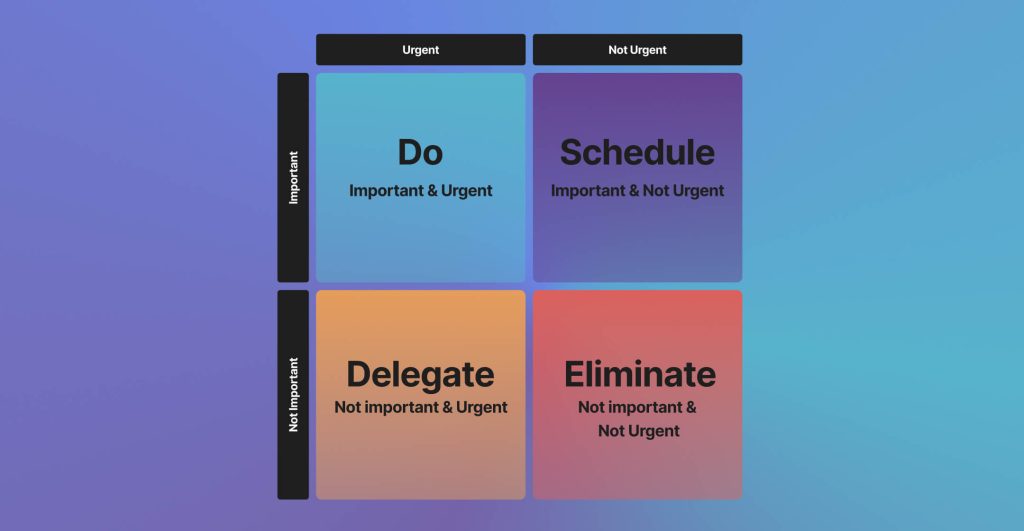
The Eisenhower Matrix divides tasks into four categories, facilitating clearer decision-making:
- Urgent and Important: Tasks that fall into this category must be addressed immediately. Examples include project deadlines, crisis management, or urgent client requests. Failing to prioritize these can lead to missed opportunities or serious setbacks.
- Important but Not Urgent: These tasks are essential for long-term success but do not require immediate action. Things like strategic planning, professional development, or relationship building reside here. Scheduling dedicated time slots for these can lead to significant personal and professional growth.
- Urgent but Not Important: While these tasks may demand immediate attention, they often do not contribute significantly to your long-term goals. Examples might include some emails or minor requests that could be delegated. Identifying and assigning these tasks is crucial to free up time for more important activities.
- Not Urgent and Not Important: Tasks in this quadrant are often time wasters, such as excessive meetings, social media browsing, or cluttering your to-do list with low-priority items. Eliminating these can drastically increase your productivity.
Transforming Your Workflow
Optimizing productivity using the Eisenhower Matrix not only helps streamline tasks but also enhances the quality of your work. Engaging in what is known as deep work — where one concentrates on cognitively demanding activities free from distractions — can lead to extraordinary results. Research indicates that individuals who adopt methodologies like the Eisenhower Matrix can recapture valuable time from their workweek. In fact, studies show that many spend over 40% of their time on tasks misaligned with their goals.
As you navigate through the complexities of your workday, implementing this matrix can help anchor your priorities, ensuring that you work smarter, not harder. In the quest for enhanced productivity, embracing the Eisenhower Matrix could transform the way you view and tackle your tasks. With its structured approach, you can gain clarity, focus, and a renewed sense of direction. It’s time to take charge of your productivity journey!
DISCOVER MORE: Click here to enhance your focus
Implementing the Eisenhower Matrix in Your Daily Routine
To fully leverage the power of the Eisenhower Matrix, it’s essential to integrate this time management tool into your daily routine effectively. Begin by dedicating a few minutes at the start of your workday or perhaps even your week to categorize your tasks thoughtfully. The first step in this process involves writing down all tasks on a single list. This comprehensive view allows you to visualize your obligations, creating a backdrop for the crucial categorization phase.
With your tasks laid out, you can systematically sort them into the matrix’s four distinct quadrants, based on urgency and importance. Here’s how to approach this with greater depth:
- Evaluate Urgency and Importance: For each task, you must discern whether it is urgent, important, or both. For example, preparing for an upcoming presentation is both urgent and important, as it requires immediate attention and has significant consequences. Conversely, responding to an emails may seem urgent, but if it doesn’t propel your primary goals, it may not be truly important.
- Schedule Tasks: Focus on tasks that have been classified as Important but Not Urgent. This quadrant is often the richest with opportunities for growth and development. Proactively schedule dedicated time slots specifically for these tasks, whether it’s conducting research, brainstorming innovative ideas, or learning a new skill. By prioritizing these activities, you mitigate the risk of them transforming into urgent crises down the line.
- Delegate Wisely: For tasks that fall into the Urgent but Not Important quadrant, consider delegation. For instance, if daily report preparation needs to be done quickly but doesn’t require your specific expertise, entrust it to a capable teammate. Delegation not only alleviates your burden but also fosters teamwork and personal growth among your colleagues.
- Determine Elimination Criteria: The Not Urgent and Not Important quadrant often contains items that should be reconsidered or eliminated entirely. Examine this section critically; perhaps you’ve been aimlessly scrolling on social media or overcommitting to meetings that yield little value. Identifying and eliminating these distractions is vital for streamlining your schedule, allowing for more impactful pursuits.
As you begin to implement the Eisenhower Matrix system, remember that the ultimate goal is not merely time management, but to significantly enhance your focus on deep work. Engaging in this kind of concentrated effort can induce a state of flow—a term popularized by psychologist Mihaly Csikszentmihalyi—where productivity peaks, and quality of output soars. Research published by the Harvard Business Review illustrates that individuals who prioritize deep, focused work often achieve results superior to those of their multitasking counterparts.
Moreover, the Eisenhower Matrix encourages intentional decision-making regarding how you allocate your time. In an age filled with constant notifications, emails, and distractions, having a clear framework to follow can indeed be a game changer. More importantly, this method instills a sense of accountability in your daily activities, compelling you to critically assess what deserves your attention and energy.
By systematically adhering to the structure of the Eisenhower Matrix, you can transform your chaotic workload into a manageable and prioritized action plan. As you gain clarity on your responsibilities, you will unearth newfound levels of productivity, making space for that deep work that drives true innovation and success. Embrace this matrix, and watch your effectiveness soar, leading you toward your goals with clarity and purpose.
| Advantages of the Eisenhower Matrix | Impact on Productivity |
|---|---|
| Enhanced Decision-Making | The matrix allows individuals to clearly identify urgent versus important tasks, leading to smarter decisions regarding where to focus energy. |
| Clarity and Focus | By visualizing tasks, users can eliminate distractions. This process enhances deep work, allowing for maximum concentration on high-value activities. |
| Time Management | Prioritizing tasks effectively leads to better time allocation, ensuring critical tasks receive adequate attention while minimizing procrastination. |
| Reduced Stress Levels | A clear task prioritization strategy can decrease overwhelm and anxiety, promoting a calmer working environment. |
Maximizing productivity involves embracing the principles of the Eisenhower Matrix. By properly categorizing tasks, individuals can transform their approach to achieving significant goals. The framework not only promotes efficiency but also builds a sustainable work ethic that champions prioritization as a cornerstone of success. With dedicated application, the Eisenhower Matrix can serve as an invaluable tool for anyone seeking to elevate their productivity, enabling them to thrive in a demanding work landscape.
DISCOVER MORE: Click here to learn how to prioritize effectively
Strategies for Sustaining Focus and Enhancing Efficiency
Once you’ve implemented the Eisenhower Matrix in your routine, the next challenge lies in maintaining focus and leveraging your time efficiently. Achieving this balance involves not just planning but also adopting key strategies that promote deep work and minimize distractions. Here are some methods to enhance your productivity:
- Create a Distraction-Free Environment: Your physical workspace plays a crucial role in determining your level of concentration. A cluttered desk can lead to a cluttered mind. Take time to organize your environment by removing unnecessary items and minimizing noise disturbances. Emerging studies suggest that a clean, well-organized workspace can lead to increased focus and improved performance. Consider tools like noise-canceling headphones or apps that block distracting websites while you work on important tasks.
- Utilize Time Blocks: Pair the Eisenhower Matrix with the Pomodoro Technique—working in short bursts followed by brief breaks. Allocate specific time blocks to focus intensely on tasks classified as Important but Not Urgent. For example, if you schedule a 50-minute deep work session followed by a 10-minute break, it can substantially enhance your mental stamina and creativity. This method can also help you maintain sustained focus and prevent burnout.
- Set Clear Goals: Align your tasks with clear, measurable objectives. Whether it’s quantifying your expected deliverables or outlining your deadlines, having specific targets prevents ambiguity and keeps you accountable. Studies indicate that written goals are significantly more likely to be achieved than unspoken ones. Regularly revisit these goals during your daily reviews to ensure they remain aligned with your long-term vision.
- Embrace Mindfulness Practices: Incorporating mindfulness techniques—such as meditation or deep-breathing exercises—into your daily routine can enhance your focus significantly. Research from a 2021 study published in the SAGE Journals indicates that regular mindfulness practice can improve attention spans and reduce stress, creating a mental landscape that’s conducive to deep work.
- Frequent Disruption Checks: As your sense of urgency increases, you may feel the temptation to switch tasks frequently. However, this multitasking impulse can undermine your efficiency. Instead, routinely check if your current focus aligns with the Eisenhower Matrix and ask yourself if urgent tasks are truly moving you closer to your goals. If distractions persist, consider revisiting your task list and re-prioritizing to alleviate pressure.
The beauty of the Eisenhower Matrix is that it’s not a one-size-fits-all solution. Therefore, adapting it to fit your personal working style is essential. For instance, professionals in highly collaborative roles might focus more on effective delegation or on mastering the art of saying “no” to non-essential meetings. As a case in point, a project manager might find that utilizing team brainstorming sessions is far more beneficial for ideation than solitary planning.
Additionally, leveraging technology can aid in reinforcing these strategies. Tools like productivity apps that integrate the concepts of the Eisenhower Matrix enable you to track tasks on the go and remind you of priorities, thus ensuring you’re steering clear of the less important distractions.
As you incorporate these practices into your routine, you will likely notice a transformation in not only your productivity levels but also in your mental well-being. Cultivating a disciplined approach to task management through the lens of the Eisenhower Matrix ultimately paves the way for greater innovation and fulfillment in your work life.
DISCOVER MORE: Click here to learn how to optimize your daily planning
Conclusion: Elevating Your Productivity Game
The Eisenhower Matrix stands out as a powerful framework for enhancing productivity and task management, particularly for those who aspire to engage in deep work. By distinguishing between what is urgent and what is important, this tool allows you to make informed decisions about where to allocate your time and energy, fostering a more focused and effective approach to your daily tasks. As you begin to prioritize wisely, the incorporation of supporting strategies—such as creating a distraction-free environment, employing time blocks, setting clear goals, and embracing mindfulness—will further amplify your productivity.
Moreover, technology serves as an invaluable ally, with various apps available to help you track your tasks and remind you of priorities based on the Eisenhower framework. This integration not only keeps you organized but also continually reinforces your commitment to deep work. The end goal is not merely to get more done, but to make room for creative thinking, innovation, and personal growth.
Ultimately, as you embrace the principles of the Eisenhower Matrix and steadily implement these productivity strategies, you are bound to experience a significant shift in both your output and overall well-being. This transformation can open the door to deeper levels of satisfaction in your work life, enabling you to pursue your passions with renewed purpose and clarity. As you navigate the complexities of time and task management, remember that the key lies in intentional prioritization—leading you to not just a more productive life, but a more fulfilled one as well.
Related posts:
How to Create a Task Prioritization System that Works for You
Task Prioritization Strategies for Remote Workers
Effective Task Classification Methods: From the Eisenhower Method to the Priority Matrix
How Technology Can Help in Prioritizing Daily Tasks
The Importance of Flexibility in Task Prioritization in Dynamic Work Environments
The Art of Saying No: How to Prioritize Important Tasks in a World Full of Distractions

Beatriz Johnson is a seasoned productivity strategist and writer with a passion for simplifying the complexities of time management and personal organization. With over a decade of experience in efficiency optimization, she specializes in topics like workflow design, habit formation, and productivity systems for modern professionals. Through her work, Beatriz empowers readers to take control of their schedules, eliminate overwhelm, and stay ahead in today’s fast-paced world.